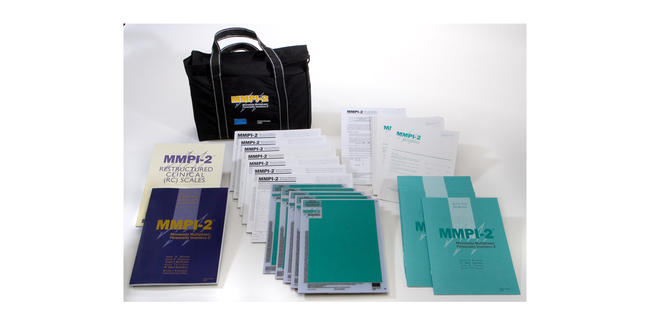
Minnesota Multiphasic Personality Inventory-2 (MMPI-2) - Frequently Asked Questions


Please choose a category:

Invalid Report and Demographic Defaults |

Abbreviated MMPI-2 |

Norms|

New Scales and Developments |

The RC (Restructured and Clinical) Scales |

Scales not offered and discontinuations|

Administration, Scoring, Interpretation help and other information |


Invalid Report and Demographic Defaults

What are the demographic default values for an MMPI-2 administration?

Demographic Default Value
Years of Education 12
Marital Status Single, Never Married (Adult Clinical System Report)
Clinical Setting Outpatient Mental Health (Adult Clinical System Report)
Occupation Other (Personnel System Reports)
Addiction Potential Standard Level Addiction Potential (Personnel System Reports)


My Extended Score Report is invalid, but it doesn't say that on the report. What is wrong?

The Extended Score Report provides profiles and scores for the MMPI-2 scales, but does not provide an interpretation. Traditional invalidity rules are not applicable to the Extended Score Report. This enables clinicians to receive all of the scale scores. When using this report, interpretation is the responsibility of the clinician. The clinician is responsible for addressing scale invalidity in his or her interpretation.

How does the Minnesota Report deal with invalid records?

The Minnesota Reports are designed to interpret only protocols that meet well-established validity criteria. Invalid protocols are dealt with in two ways: Extremely elevated and clearly invalid records are not interpreted but the record is provided along with graphs that are clearly marked INVALID. Protocols that are possibly invalid (e.g., overly defensive or exaggerated) are discussed in a section in the report called VALIDITY CONSIDERATIONS. The utility of the particular evaluation is described and estimated contingent upon the level of performance on all the validity scales. The cut-offs for different settings will vary depending upon the research available.

back to top|


Abbreviated MMPI-2

How do I enter an Abbreviated MMPI-2 test in Q Local software?

To facilitate an Abbreviated MMPI-2 test administration, all of the items needed to score the 10 Clinical Scales and Validity Scales L, F, and K appear within the first 370 items. If you choose to administer an Abbreviated test administration, it is recommended that you print a Basic Service Report. The Basic Service Report is a one-page profile of these 13 scales. All other reports contain scales with items that fall beyond 370 and are therefore incomplete with an Abbreviated test administration. To enter an Abbreviated MMPI-2 test in Manual Entry, simply enter a “2” for “Abbreviated” under “Type” in the demographics. Enter the client’s responses to the first 370 items of the test only, then save and print. To administer an Abbreviated MMPI-2 test in On-Screen Entry, choose “Abbreviated” in the administrator demographics when this option appears. The On-Screen administration will end after the first 370 items are administered.

Do clients need to respond to items beyond 370 to receive the MMPI-2 Basic Service Report?

No. The Basic Service Report only provides information on 3 Validity Scales (L, F, K) and the 10 Clinical Scales, which are located in the first 370 items. Items beyond 370 will not be considered for the basic profile.

What scales can be scored if only the first 370 items are administered?

Validity (L, F, K), Clinical, and Clinical Subscales (Harris-Lingoes and Si Subscales).

If I have a client answer the first 370 items and choose to print an Extended Score Report, will I have scorable Validity Indicators (L, F, K), Clinical Scales, and Clinical Subscales (Harris-Lingoes and Si Subscales)?

Yes. These scales will be scorable, but any scales with items that fall beyond 370 will not be complete (e.g., more recent Validity Indicators, RC [Restructured Clinical] Scales, Content Scales, Supplementary Scales).

back to top|


Norms

Are different norms used for the different settings?

There are different norms for the MMPI-2 and MMPI-A tests. The normative sample of the MMPI-2 instrument consists of 2,600 individuals, age 18 or older, who were selected as a representative sample of the US population.

The three Minnesota Reports for adults (Adult Clinical System, Forensic, and Personnel System) use the same normative sample. However, in some settings data on specific personnel applications are also provided. In all settings, specific frequency data aid in the interpretation of the report by providing an empirical perspective with which to compare profiles.

The MMPI-A norms that are used for adolescents were obtained on a national sample of adolescents between 14 and 18 years of age. There were 805 boys and 815 girls from 8 regions of the United States.

Are there norms for different cultures for the MMPI-2 test?

American minorities are included in the normative sample. There are no separate cultural norms available.

back to top|


New Scales and Developments

What are the new PSY-5 scales and where can I find information about them?

Harkness and McNulty developed a model for assessing psychopathology based on the "Big Five" model of personality. They selected items from the MMPI-2 item pool that matched their model and developed five scales: Aggressiveness (AGGR), Psychoticism (PSYC), Discontraint (DISC), Negative Emotionality/Neuroticism (NEGE), and Introversion/Low Positive Emotionality (INTR). The Personality Psychopathology Five Scales (PSY-5) were introduced in 2001 and are available on the Extended Score Report, the Minnesota Reports, and in the hand-scoring Supplementary Scales materials. Additional information about the PSY-5 Scales can be found in the revised MMPI-2 Manual for Administration, Scoring, and Interpretation (2001) or the PSY-5 Test Report (University of Minnesota Press).

Why were the validity scales re-ordered?

The validity scales were re-ordered and plotted together on reports to enable test users to refine their evaluation of profile interpretability. The revised ordering of the validity scales reflects the recommended sequence for developing an interpretation of the scales: measures of inconsistent responding (VRIN, TRIN), measures of infrequent responding (F, FB, FP), and measures of defensive responding (L, K, S).

Why were the supplementary scales revised and re-ordered?

The Supplementary Scales Profile was revised by the addition of the MMPI-2 version of the Cook/Medley Hostility scale (Ho) and the deletion of the Schlenger Post-Traumatic Stress Disorder scale (PS) and the Social Introversion Subscales (Si). The PS scale is no longer offered. The Si Subscales are available with the Harris-Lingoes Subscales but are not profiled. The Supplementary Scales were re-ordered to enhance interpretability: A, R, Es, Do, Re (scales representing or related to familiar normal-range personality constructs); Mt, PK, MDS (indicators of generalized emotional distress with a clinical emphasis); Ho, O-H, MAC-R, AAS, APS (indicators of behavioral dyscontrol, the last three focusing on substance abuse); and GM, GF (gender-role scales).

back to top|

Which MMPI-2 reports contain non-gendered norms?

Non-gendered T scores appear in the Revised Personnel System, 3rd Edition Reports, the Reports for Forensic Settings, and the Extended Score Report. It is possible to suppress the non-gendered T scores in printing these reports. A test monograph covering the development and use of the non-gendered norms is available from the University of Minnesota Press and Pearson.

Are non-gendered norms available for all MMPI-2 scales?

Yes.

If I don't want to use the non-gendered T scores, can they be suppressed?

Yes. The ability to suppress the non-gendered T scores is a print report option for the Personnel Interpretive, Personnel Adjustment Rating, Reports for Forensic Settings, and Extended Score reports.

Are the non-gendered T scores K-corrected?

In the Extended Score Report, both K-corrected and non-K-corrected non-gendered T scores may be printed. Users may suppress printing of the non-gendered and non-K-corrected T scores if they choose.

back to top|

Why were the non-gendered T scores revised?

A complete set of non-gendered T scores for all MMPI-2 scales is provided in a test monograph by Yossef S. Ben-Porath and Johnathan D. Forbey titled "Non-Gendered Norms for the MMPI-2," published by the University of Minnesota Press (2003). The monograph documents the rationale for, as well as the development and use of, non-gendered norms for the MMPI-2. Provisional non-gendered norms for a subset of the MMPI-2 scales were included in earlier versions of the Minnesota Reports. The non-gendered T scores reported in all current MMPI-2 products and in the monograph by Ben-Porath and Forbey (2003) differ minimally from the provisional non-gendered T scores because of slight changes in the composition of the non-gendered normative sample.

Where can I find more information on the non-gendered norms?

The rationale, development, and use of non-gendered norms for the MMPI-2 test are documented in a test monograph authored by Yossef S. Ben-Porath and Johnathan D. Forbey and published by the University of Minnesota Press (2003). This document also contains tables for converting raw scores to non-gendered T scores for all MMPI-2 scales. This test monograph is available from Pearson (product # 29453).

Which MMPI-2 reports contain non-K-corrected T Scores?

An optional profile of the Validity and Clinical Scales incorporating non-K-corrected T scores appears in the Extended Score Report. This profile may be printed in addition to the standard Validity and Clinical Scales Profile. Although non-K-corrected T scores are available in the Extended Score Report only, Appendix A of the revised MMPI-2 Manual for Administration, Scoring, and Interpretation (product # 24027) provides both K- and non-K-corrected T scores, and a hand-scoring Validity and Clinical Scales Profile form for K- and non-K-corrected norms is available (product # 24006).

back to top|

If I don't want to use the non-K-corrected T scores, can they be suppressed?

Yes, the ability to suppress the non-K-corrected T scores is a print report option for the Extended Score Report.

Why were non-K-corrected T scores re-introduced in the Extended Score Report?

Recently published research indicates that the K correction does not enhance validity and that in some cases validity is actually attenuated by the K correction. Non-K-corrected T scores allow interpreters to examine the relative contributions of the clinical scale raw score and the K correction to K-corrected clinical scale T scores. This information may be particularly helpful when the K score deviates substantially from the average T-score range (<40 or >65). Because all other MMPI-2 scores that aid in the interpretation of the Clinical Scales (the Harris-Lingoes Subscales, Restructured Clinical Scales, Content and Content Component Scales, PSY-5 Scales, and Supplementary Scales) are not K-corrected, they can be compared most directly with non-K-corrected T scores.

Important information about The Minnesota Report™: Adult Clinical System—Revised, 4th Edition (product code 51487).
Arguably the gold standard interpretive report series for the MMPI-2 test, The Minnesota Report has proven to be an effective, efficient diagnostic and treatment planning tool for 20 years. Developed and updated on Q Local™ software, version 1.2 by noted MMPI-2 expert, James N. Butcher, PhD, the 4th edition of this premier MMPI-2 interpretive report series introduces the following:

  • Expanded narrative sections incorporating current research
  • Updated User's Guide to help you put the reports to work
  • Newly added Alcohol and Drug Treatment setting

back to top|


The RC (Restructured Clinical) Scales

Are the RC Scales considered "experimental?" Why not?

They are not considered “experimental” because sufficient data exist to support their recommended use in practical applications of the MMPI-2 test and they are part of the standard test materials. The Test Monograph by Tellegen, Ben-Porath, McNulty, Arbisi, Graham, and Kaemmer (2003) provided initial empirical data to guide RC Scale interpretation. Subsequent research provides further data to guide and support RC Scale interpretation.

Do the RC Scales replace the Clinical Scales? Can I disregard the Clinical Scales and look only at the RC Scales profile?

The RC Scales do not replace the Clinical Scales. They provide a more clearly focused assessment of the primary distinctive components of the Clinical Scales. The RC Scales can serve as the overall framework or roadmap for interpreting the MMPI-2; the Clinical, Content, and Supplementary Scales provide corroboration and elaboration of these results.

Can I administer just the items that comprise the RC Scales as a "short" MMPI-2 administration, similarly to administering the first 370 items and printing the Basic Service Report (includes 10 Clinical Scales and 3 Validity Scales--L, F, K)?

No. The RC Scales are not a shortened version of the MMPI-2 test. They include items that appear after item 370 in the MMPI-2 booklet. A shorter, restructured version of the MMPI-2 in which the RC Scales serve as the core scales, is in development.

back to top|

Is there a plan to discontinue the Clinical Scales?

There is no plan to discontinue the Clinical Scales.

Are the Clinical Scales less valid than the RC Scales?

Research has established that in comparison with the Clinical Scales, the RC Scales have comparable to improved convergent validity and substantially improved discriminant validity.

How should I incorporate the RC Scales into my evaluations?

The RC Scales can serve as a roadmap for interpreting an MMPI-2 protocol by providing a more clearly focused assessment of the distinctive components of the Clinical Scales. The user can corroborate interpretive inferences indicated by the RC Scales by considering scores on the Clinical Scales, code types, Clinical Subscales (Harris-Lingoes), Content Scales, and certain Supplementary Scales.

Can the RC Scales be used in forensic assessments?

Depending on the jurisdiction in which the forensic examiner practices, one of two legal standards for the admissibility of MMPI-2-based expert testimony apply. The “Daubert” standard requires that the scientific validity of any inferences based on the RC Scales be documented. The "Frye" test requires that a procedure relied on by the expert be generally accepted in the discipline. Forensic opinions guided by the RC Scales can withstand a Daubert challenge, provided that the assessor has relied appropriately on the RC Scales in supporting her or his opinion, and she or he is sufficiently well versed in the literature on these measures. Because it is rarely necessary to rely on the RC Scales exclusively in MMPI-2 interpretation, and since other generally accepted MMPI-2 sources are likely to agree with inferences indicated by the RC Scales, in most cases the RC Scales can also be relied upon in jurisdictions governed by the Frye test.

back to top|

What if I don't want the RC Scales in my report as a forensic psychologist?

The RC Scales are part of the standard output for the MMPI-2 Extended Score Report. A user may choose not to incorporate them in an MMPI-2 interpretation.

As a forensic psychologist, what do I say about the validity and reliability of the Clinical Scales now that we have the RC Scales, which have improved convergent and discriminant validity? How does this affect past cases for which I depended upon the Clinical Scales?

The validity and reliability data on the Clinical Scales remain unchanged. Interpretation of RC Scale scores as recommended can serve to enhance further the validity of MMPI-2 interpretation.

How do I explain discrepancies between what the Clinical Scales and the RC Scales report?

When differences occur, they are not “discrepancies” but, rather, improvements provided by the RC Scales as a result of removing the non-specific variance associated with Demoralization, the K correction, and the subtle items. If a Clinical Scale is elevated and its RC Scale counterpart is not, the correlates associated with that scale should not be emphasized in the interpretation (unless indicated by other MMPI-2 scale scores). If an RC Scale is elevated and its Clinical Scale counterpart is not, the correlates associated with that scale should be incorporated in the interpretation.

back to top|

What kind of documentation is available for the RC Scales?

A Test Monograph by Tellegen, Ben-Porath, McNulty, Arbisi, Graham & Kaemmer (2003), titled “The MMPI-2 Restructured Clinical (RC) Scales: Development, Validation, and Interpretation” includes: an introduction providing the rationale for creating the RC Scales, information about how the scales were developed, detailed psychometric data on the reliability and validity of the RC Scales, recommendations for interpreting the RC Scales, case examples illustrating RC Scale interpretation, and a discussion of future directions in RC Scale research and application. This document also contains extensive appendixes providing the item composition of the scales and raw to uniform T-score conversion tables. (Available now, Product # 29433). A number of publications on the RC Scales have appeared in the journal and book literature subsequent to publication of the Test Monograph.

Do you have references or articles on the RC Scales?

A Test Monograph by Tellegen, Ben-Porath, McNulty, Arbisi, Graham & Kaemmer (2003), titled “The MMPI-2 Restructured Clinical (RC) Scales: Development, Validation, and Interpretation” includes: an introduction providing the rationale for creating the RC Scales, information about how the scales were developed, detailed psychometric data on the reliability and validity of the RC Scales, recommendations for interpreting the RC Scales, case examples illustrating RC Scale interpretation, and a discussion of future directions in RC Scale research and application. This document also contains extensive appendixes providing the item composition of the scales and raw to uniform T-score conversion tables. (Available now, Product # 29433). A number of publications on the RC Scales have appeared in the journal and book literature subsequent to publication of the Test Monograph.

back to top|

What is the research base for the RC Scales?

The development and validation of the scales is documented in the first chapter of a Test Monograph by Tellegen, Ben-Porath, McNulty, Arbisi, Graham & Kaemmer (2003), titled “The MMPI-2 Restructured Clinical (RC) Scales: Development, Validation, and Interpretation.”

How were the RC Scales developed?

The development of the scales is documented in the first chapter of a Test Monograph by Tellegen, Ben-Porath, McNulty, Arbisi, Graham & Kaemmer (2003), titled “The MMPI-2 Restructured Clinical (RC) Scales: Development, Validation, and Interpretation.” The author of the scales, Auke Tellegen, first developed a demoralisation scale, extracting the general complaint or malaise factor from the existing Clinical scales. He then identified the major dimensions of eight of the ten scales, excepting Scales 5 and 0, and constructed scales measuring those dimensions.

Do the RC scales contain the same items as the Clinical Scales? Which items were dropped, were there new items included?

Each of the RC Scales includes items that also appear on the original Clinical Scales and others that do not. The item composition of the RC scales is provided in Appendix A of a Test Monograph by Tellegen, Ben-Porath, McNulty, Arbisi, Graham & Kaemmer (2003), titled “The MMPI-2 Restructured Clinical (RC) Scales: Development, Validation, and Interpretation.” (Available now, Product # 29433)

back to top|

Do the RC Scales overlap?

No, they do not. It was the intent of the scales’ developer, Auke Tellegen, to construct scales that would each measure a major distinctive dimension currently embedded in the Clinical scales.

What are the intercorrelations of the RC Scales, and in comparison, of the Clinical Scales?

Intercorrelations of both sets of scales on several samples are provided in Tables 4-6 through 4-12 of a Test Monograph by Tellegen, Ben-Porath, McNulty, Arbisi, Graham & Kaemmer (2003), titled “The MMPI-2 Restructured Clinical (RC) Scales: Development, Validation, and Interpretation.”

What are the test-retest reliabilities of the RC Scales?

This data is provided in Tables 4-4 and 4-5 of a Test Monograph by Tellegen, Ben-Porath, McNulty, Arbisi, Graham & Kaemmer (2003), titled “The MMPI-2 Restructured Clinical (RC) Scales: Development, Validation, and Interpretation.”

What are the internal consistencies of the RC Scales?

This data is provided in Tables 4-4 and 4-5 of a Test Monograph by Tellegen, Ben-Porath, McNulty, Arbisi, Graham & Kaemmer (2003), titled “The MMPI-2 Restructured Clinical (RC) Scales: Development, Validation, and Interpretation.”

back to top|

Why don't scales 5 and 0 have corresponding RC Scales? Will they have RC Scales?

The RC Scales were designed to measure clinical phenomena. Scale 5 does not assess a currently recognized clinical disorder, and Scale 0 measures a normal–range personality trait. A shorter, restructured version of the MMPI-2, anchored by the RC Scales, is in development. It will include scales that assess constructs associated with Clinical Scales 5 and 0.

Why are the RC Scales only available in the MMPI-2 Extended Score Report?

A shorter, restructured version of the MMPI-2, anchored by the RC Scales, is in development. Interpretive reports will be available for the restructured version of the MMPI-2. Q Local users can print a free Extended Score Report (no usage required) for any previously printed MMPI-2 interpretive report. If you utilize our mail-in scoring service for MMPI-2 interpretive reports, simply request a free Extended Score Report when you submit your pre-paid interpretive report answer sheet to us for processing (will be provided in addition to your interpretive report).

back to top|

When will the RC Scales appear in other reports?

A shorter, restructured version of the MMPI-2 test, anchored by the RC Scales, is in development. Interpretive reports will be available for the restructured version of the MMPI-2.

When will information on the RC Scales appear in the MMPI-2 manual?

In the next edition of the manual.

Can I apply existing Clinical Scale code-type research to the RC Scales?

Existing MMPI-2 code-type research is not usable with the RC Scales. However, the RC Scales address more directly the interpretive challenges that led to the development of the code-type interpretation approach. Detailed discussion of this subject is provided in a Test Monograph by Tellegen, Ben-Porath, McNulty, Arbisi, Graham & Kaemmer (2003), titled “The MMPI-2 Restructured Clinical (RC) Scales: Development, Validation, and Interpretation.”

back to top|

What is the demoralisation scale?

The demoralisation scale provides an appraisal of the test-taker’s current overall sense of well-being. As such, it can be the starting point for RC scale interpretation. It was constructed by extracting from the Clinical Scales the general complaint or malaise factor, which is present in all the Clinical Scales as well as in most other MMPI-2 scales.

Do I use the traditional cut-offs to evaluate elevations on the RC Scales?

Yes, with the same precautions one should use for employing any recommended cut-offs, namely that they be considered guidelines identifying points at which the interpretive focus should shift rather than as fixed points demarcating qualitative change.

How can I get the RC Scales for a previously scored MMPI-2 Extended Score Report record in my Q Local software?

The RC Scales were launched in January 2003 in the MICROTEST Q software version 5.05 “patch.” The RC Scales are included in this version and all software versions higher than 5.05 “patch” and in all versions of the Q Local software. Simply reprint any previously scored MMPI-2 Extended Score Report records to receive the RC Scales. No additional usages will be required for previously scored records.

Are the RC Scales K-corrected? Why not?

The RC Scales are not K-corrected. Research indicates that the K correction either does not affect the validity of the Clinical Scales (in clinical settings) or significantly attenuates the validity of the scales (in non-clinical settings). Therefore, a K correction is not applied on the RC Scales.

back to top|

Will the RC Scales facilitate a shortened version of the MMPI-2 test in the near future?
A shorter, restructured version of the MMPI-2, anchored by the RC Scales, is in development.

Clinical Scale 3 and RC3 don’t measure the same thing and are not highly correlated. Why is that?

Clinical Scale 3 is a heterogeneous measure that includes several distinctive components. The primary component is somatic complaints, which are assessed by RC1. A smaller, secondary component is disavowal of cynicism, which is assessed by RC3. However, because disavowal of cynicism is negatively correlated with psychopathology, the scoring for the scale was reversed, and RC3 was labeled Cynicism. The somatic preoccupation coupled with naiveté reflected in a highly elevated score on Scale 3, will appear as a combination of an elevated score on RC1 and a low score (below T score 40) on RC3.

The RC Scales seem to overlap with the Content Scales. What’s the difference between the RC Scales and the Content Scales?

Although they have similar labels, there is relatively limited overlap between the RC Scales and the Content Scales. The primary differences between the two sets of scales are that several Content Scales are highly saturated with Demoralization (Anxiety, Depression, Low Self- Esteem, Work Interference, and Negative Treatment Indicators), and some Content Scales confound different elements assessed by the RC Scales. For example, the Content Scale Anti-social Practices confounds characteristics assessed by RC3 and RC4, and the Content Scale Bizarre Mentation confounds characteristics assessed by RC6 and RC8.

back to top|

What’s the difference between Content Scale Cynicism and RC3?

The Content Scale Cynicism (CYN) is broader in scope than RC3. RC3 focuses exclusively on non-self-referential beliefs in human badness, while, CYN also includes self-referential beliefs, which are assessed by RC6. Therefore, the RC Scales allow for a differentiation between self-referential and non-self-referential beliefs in others’ malevolence, whereas these two components are confounded in the Content Scale CYN.

Do the RC Scales have utility with non-clinical populations that typically produce within normal limits profiles, like personnel/employee testing and child custody evaluations?

The RC Scales are equally effective with clinical and non-clinical populations. In some cases, the absence of demoralization in individuals assessed in non-clinical settings results in artifactual attenuation of scores on the Clinical Scales. Because the RC Scales are less saturated with demoralization, this artifact is less likely to occur and more specific problems (e.g., antisocial behavior) will more likely be identified.

Multiple elevations on the Clinical Scales make sense because clinical syndromes are complex and there are high rates of comorbidity with disorders.

How do the simplified, non-overlapping RC Scales tap into this?
Multiple elevations on the Clinical Scales may stem from comorbidity OR demoralization, making it difficult to accurately determine the presence of comorbid and complex syndromes. Removal of demoralization from the RC Scales enables users to more accurately identify the necessary elements of a syndrome or the occurrence of comorbidity.

back to top|

How do I interpret an RC Scales profile where demoralisation is the only elevated scale?

Such a profile would indicate that the individual is generally unhappy and dissatisfied with her or his life and is likely to describe herself or himself as experiencing anxiety and depression. The person likely has low self-esteem, tends to ruminate about perceived failures, and expects to fail in future endeavors.

Current interpretive guidelines suggest that clinicians incorporate the RC Scales and non-K-corrected T scores, so why does Pearson offer interpretive reports that don’t include these measures?

It is the opinion of the author of the current interpretive reports offered for the MMPI-2 test that not enough is known about these developments to warrant their incorporation in the interpretive reports (The Minnesota Reports). A shorter, restructured version of the MMPI-2, anchored by the RC Scales, is in development. Interpretive reports will be available for this version of the MMPI-2. Q Local users can print a free Extended Score Report (no usage required) for any previously printed MMPI-2 interpretive report. If you utilize our mail-in scoring service for MMPI-2 interpretive reports, simply request a free Extended Score Report when you submit your pre-paid interpretive report answer sheet to us for processing (will be provided in addition to your interpretive report).

How do I interpret an MMPI-2 with a well-defined and elevated code type in the absence of elevations on the RC Scales? Should I rely on the code type?

A profile with a well-defined Clinical Scale code type without any elevation on the RC Scales will most likely occur when the K correction adds significant variance to the Clinical Scale scores. The non-K-corrected profile will likely not be elevated. Research indicates that in such cases the non-elevated RC Scales and non-K-corrected Clinical Scales provide a more accurate indication of the test-taker’s functioning.

back to top|

What is a well-defined code type (for the original Clinical Scales)?

In a well-defined code type, the T scores of the scales comprising the code type reach an elevation of 65 or higher, and are five or more T score points higher than the T scores on the remaining Clinical Scales.

How do I interpret an elevation on one or more RC Scales in the absence of any elevations on the Clinical Scales?

Elevation on an RC Scale in the absence of elevation on its Clinical Scale counterpart is most likely to occur when the absence of demoralisation, a low score on K, or subtle items artifactually attenuate the score on the Clinical Scale. The elevated score on the RC Scale will give a more accurate indication of the individual’s functioning and should be incorporated in the interpretation.

back to top|


Scales not offered and discontinuations

Why were the Wiener-Harmon Subtle-Obvious Subscales removed from the Extended Score Report?

The University of Minnesota Press and Pearson discontinued offering the Wiener-Harmon Subtle-Obvious Subscales in all MMPI® products. The subscales were retained in the MMPI-2 instrument to encourage further research in the hope that additional data would answer questions about their utility. It is the opinion of the Press's consultants that data collected subsequent to the publication of the MMPI-2 instrument in 1989 and reported in journal articles, as well as earlier studies, indicate that these subscales should no longer be offered. A majority of surveyed MMPI-2 clinician-researchers expressed the same opinion.

The decision reflects the lack of empirical evidence supporting the validity of the subtle-obvious distinction as implemented in the Subtle-Obvious Subscales. There is no good evidence that the Subtle Subscales indicate psychopathology more validly than the Obvious Subscales when respondents fake bad or good or over- or underreport their psychological difficulties.

Lack of supporting evidence and concern about the potential misuse of the Subtle-Obvious Subscales in clinical, forensic, and other applied settings have become compelling reasons for removing these subscales from the list of standard MMPI offerings.

back to top|

Why is the Schlenger PTSD scale (PS) no longer available on the MMPI-2 test?

Although both scales were normed on veterans, the Keane scale (PK) was developed to differentiate PTSD patients from other psychiatric patients. The Schlenger scale (PS) was developed to separate normals from PTSD patients. Research conducted to date shows that the Keane scale (PK) is a stronger, more useful measure for classifying patients with PTSD.

Why was the occupation “Air Traffic Controller” discontinued in the Personnel Reports?

Air Traffic Controller was discontinued because the sample size was considered too small for base rate calculation. You may still process prior reports which indicate this occupation, however, the occupation will default to “other.”

back to top|

Important information regarding the discontinuation of The Minnesota Report: Alcohol and Drug Treatment System (product code 51443).

The Minnesota Report: Alcohol and Drug Treatment System has been revised and incorporated into the recently updated Adult Clinical System—Revised, 4th Edition. Look for this newly added setting (setting 8) in The Minnesota Report: Adult Clinical System—Revised, 4th Edition. With the introduction of this setting in the Adult Clinical System—Revised, 4th Edition, we have discontinued the prior version of The Minnesota Report: Alcohol and Drug Treatment System. Listed below is some important discontinuation information for the users of The Minnesota Report: Alcohol and Drug Treatment System.

With the discontinuation of the Alcohol/Drug Treatment System, what happens to my unused reports?

When Q Local software, version 1.2 is opened, any unused reports for the Alcohol and Drug Treatment System (product code 51443) will be converted to reports for the Adult Clinical System–Revised, 4th Edition (product code 51487).

With the discontinuation of the Alcohol and Drug Treatment System, how do I reprint these reports?

To reprint an Alcohol and Drug Treatment System report, highlight the assessment record and go into Edit. Enter 8 (Alcohol/Drug Treatment) for the clinical setting in the Edit Assessment Record window, then click Save Changes. With the assessment record still highlighted, go into Score and Report. Choose the Adult Clinical System–Revised, 4th Edition report in the Score and Report window, then click Continue. A report usage will not be required or subtracted to reprint this report.

back to top|


Administration, Scoring, Interpretation help and other information

What is the Minnesota Report?

The Minnesota Report is a computer-based interpretation system for the MMPI-2 and MMPI-A instruments for psychologists. The Minnesota Report is essentially an "electronic textbook" or resource guide that provides the most likely test interpretations for a particular set of MMPI-2 or MMPI-A scores in a particular setting.

Why are there different settings for the Minnesota Report? Do the reports differ for the various settings? What information is used to develop different personality interpretations?

There are setting-specific versions of the Minnesota Report for several reasons:

  1. The nature and goals of a psychological evaluation differ according to the reason for referral. For example, in clinical settings clinical diagnosis and treatment potential are important considerations while these are not goals in personnel or forensic settings.
  2. The client is likely to approach the assessment task very differently in each of these settings. Thus, the assessment of protocol validity differs according to setting.
  3. The typical performance on the scales and indices of the MMPI-2/MMPI-A instruments differs somewhat by type of application. Therefore, the base rates of scores vary according to setting. More specifically, interpretations can be made for MMPI scores if the frequency of typical performance is included in the analysis. For example, in correctional facilities there is a high rate of Pd scale elevations and in medical settings Hs and Hy are more prominent.
  4. The reports will vary in terms of information provided, relative performance on the different indices, and research information available for each setting. In addition, different scale-behavioral correlates can be found in different settings. For example, the association between the Pd and Sc scales and aggressive acting-out behavior are more prominent in correctional settings than in medical settings.

back to top|

Can the Minnesota Report computer printout serve as a complete and independent psychological report on a client?

No, as noted on each report, the statements contained in the narrative represent a professional-to-professional consultation and do not serve as an independent or "stand-alone" report. The statements represent a "best estimate" or the most likely write-up for a given profile pattern. The information provided in the Report is analogous to an "electronic textbook."

The narrative report is based on objectively derived scale indices and scale interpretations that have been developed in diverse groups of patients. The computer simply references the extensive research literature on the MMPI-2 scores and indexes, evaluates the particular pattern of scores that a client produces, and locates in the database the most pertinent personality and symptomatic information from the research literature. This MMPI-2 interpretation can serve as a useful source of hypotheses about clients.

Where can I find further information about the Minnesota Report?

The User's Guides for the Minnesota Report are available from Pearson.

Butcher, J. N. (2005). MMPI-2 User's guide. The Minnesota Report: Adult clinical System—Revised, 4th Edition. Minneapolis, MN: Pearson Assessments.

Butcher, J. N. (2002). MMPI-2 User's guide. The Minnesota Report: Personnel System—Revised, 3rd Edition. Minneapolis, MN: Pearson Assessments.

Butcher, et al. (1997). MMPI-2 User's guide. The Minnesota Report: Reports for Forensic Settings. Minneapolis, MN: Pearson Assessments.

Butcher, J. N., & Williams, C. L. (1992). MMPI-A User's guide for The Minnesota Report: Adolescent Interpretive System. Minneapolis, MN: Pearson Assessments.

back to top|

What is the difference between the Depression scale in the Clinical Scales and the Depression scale in the Content Scales?

The Depression scale in the Clinical Scales is a heterogeneous measure of depression (it measures more than one facet of depression). This scale was developed on psychiatric patients with various forms of symptomatic depression. The Depression scale in the Clinical Scales measures discomfort and dissatisfaction with life, characterized by poor morale, lack of hope in the future, denial of happiness and self-worth, withdrawal, psychomotor retardation, and other facets of symptomatic depression.

The Depression scale in the Content Scales measures only one facet of depression, self-reported depressive thoughts.

What is the difference between the MAC-R scale and the Addiction Potential Scale?

The MAC-R scale has 49 items. The newer Addiction Potential Scale has 39 items. Many of the items on the Addiction Potential Scale are different from those on the MAC-R scale. The Addiction Potential Scale items concern personality dimensions and life situations associated with substance abuse. The Addiction Potential Scale is commonly used with the Addiction Admission Scale.

back to top|

Where can I find information about the content validity, construct validity, and criterion validity of the MMPI-2 instrument?

Several of the MMPI-2 reference books have this information including John Graham's MMPI-2: Assessing Personality and Psychopathology (Oxford Press) and James Butcher and Carolyn Williams’s Essentials of MMPI-2 and MMPI-A Interpretation (University of Minnesota Press). Both of these books are available from Pearson.

Are there tables in the MMPI-2 manual with conversion data for item order from MMPI items to MMPI-2 items?

Yes, in Appendix H of the revised MMPI-2 Manual for Administration, Scoring, and Interpretation (2001).

Does the MMPI-2 instrument measure PTSD?

Yes, the MMPI-2 instrument has a PTSD measure, the PK scale (normed on veterans).

back to top|

Does Pearson have any information regarding the Megargee Classification System for the MMPI-2?

Information on how the MMPI-2 Megargee Classification System rules were developed can be found in the revised MMPI-2 Manual for Administration, Scoring, and Interpretation (2001) and Classifying Criminal Offenders with the MMPI-2 (University of Minnesota Press) by Megargee, Carbonell, Bohn, and Sliger.

Can I use the Criminal Justice and Correctional Report with women or is it only useful for men?

Yes, but you won’t get all the information you get for a male respondent. For women, the Criminal Justice and Correctional Report will present a Megargee Classification and scores/profiles for all the Validity, Clinical, Supplementary, and Content Scales included in the report. The critical items related to self-injury and suicide and the omitted items sections are also included. The report will not provide ratings on the nine Behavioral Dimensions, and it will not identify Possible Problem Areas. This is because sufficient research has not yet been conducted on these areas with female offenders.

Can the Criminal Justice and Correctional Report be used to screen corrections officers?

No. The Criminal Justice and Correctional Report is designed to be used with inmates and offenders in the criminal justice system. For personnel selection, use either the Personnel Interpretive Report or the Personnel Adjustment Rating Report.

back to top|

When was the Megargee Offender Classification System removed from the MMPI-2 Adult Clinical Interpretive Report and the MMPI-2 Reports for Forensic Settings, and why?

The Megargee Offender Classification System was removed from these two reports in January 2003. The author of this special index for the MMPI-2 test, Edwin I. Megargee, PhD, CCHP, has developed a new report for use with criminal offenders, the MMPI-2 Criminal Justice and Correctional Report. Based on decades of research conducted in correctional settings, this report includes the widely respected Megargee Offender Classification System in addition to nine Behavioral Dimensions and nine Possible Problem Areas. Please ask us how the MMPI-2 Criminal Justice and Correctional Report can help you make important offender to offender comparisons and address demands to classify criminal offenders effectively and economically.

What are the differences between the MMPI-2 manual and user's guides?

The manual contains basic information about administering, scoring, and interpreting the test and should be purchased with every first-time MMPI-2 order. The user's guides document the development of a given interpretive report and describe its contents. A report user’s guide should be purchased with each first-time order of an MMPI-2 interpretive report.

Can adolescents take the MMPI-2 assessment and receive valid results?

We recommend using the MMPI-A assessment with adolescents. A cautionary statement will be generated for MMPI-2 test takers under 19 because no adolescents were included in the normative sample.

back to top|

Is the MMPI-2 instrument able to discriminate between neuropsychological disorders and conversion disorders/somatization disorders?

We will not be able to give a definitive answer until research has been done in this area.

Are all MMPI-2 scales copyrighted?
Yes.

Is the MMPI-2 instrument appropriate for use with chronic pain patients?
Yes, see the Keller and Butcher book, Assessment of Chronic Pain Patients With the MMPI-2 (University of Minnesota Press). This book is available from Pearson.

What does the chronic pain classification 1,2,3,4,0 mean?
1=P, 2=A, 3=I, 4=N, 0=does not fit any typology. See Costello, R. M., Hulsey, T. L., Schoenfeld, L. S., & Ramamurthy, S. (1987). P-A-I-N: A four-cluster MMPI typology for chronic pain. Pain, 30, 199–209.

back to top|

What is the meaning of each pain classification, P-A-I-N-0 (or 1-2-3-4-0)?

  • Type P: This appears to be the most pathological of the four types. Most of the scales will be significantly elevated. Type P patients are usually the least educated and most often unemployed. They have the lowest monthly income compared to the other types. Type P patients make extreme claims about physical, psychological, and social distress.
  • Type A: This type is uniquely characterized by a "conversion V" on the Hs, D, and Hy scales. Type A does not have any significant demographic correlates.
  • Type I: This type has significant elevations only on scales Hs, D, and Hy. Type I patients seem to have chronic medical histories (i.e., multiple surgeries or hospitalizations). Type I patients may not improve physically with treatment, but they appear to experience some degree of psychological benefit.
  • Type N: This type has normal-range profiles. The only exception may be an elevated K. Type N patients tend to be more moderate in their health claims. Also, Type N patients tend to be employed, better educated, and more responsive to treatment than other types.
  • Type 0: A Pain Classification of "0" signifies that the profile did not match any of the typologies. This does not mean that chronic pain is not present. (Please note that if the L scale score is greater than 65T, the program will automatically drop through the P-A-I-N classification and the client will be classified as "0.")

Should I use the MMPI-2 instrument in light of the ADA (Americans with Disabilities Act) and Civil Rights Act?

Pearson cannot offer legal advice and we recommend that you seek the opinion of competent employment counsel to ensure that the most appropriate advice can be provided for your individual circumstances. However, the ADA's apparent impact on the use of the MMPI-2 instrument relates to the timing of the administration. The MMPI-2 instrument appears to be classified as a medical examination under the ADA, and hence must be administered subsequent to a conditional offer of employment being tendered by an employer. The Civil Right s Act of 1991 ("CRA"), appears to impact the use of the MMPI-2 instrument with respect to the use of norms. Under the CRA it is inappropriate to use either race or sex norms when utilizing tests in the employment domain.

back to top|

Can I still use the administrations I have for the MMPI-2 Extended Score PLUS Report (product code 51439)?

No, the MMPI-2 Extended Score PLUS Report (product code 51439) was discontinued and subsequently removed from the software. If you believe you have unused administrations for this report and would like to exchange them for the MMPI-2 Extended Score Report (product code 51438), you will need to return your report counter to Pearson Assessments. Call 800-627-7271 to arrange for a return and exchange.

The Extended Score PLUS Report (51439) was discontinued because it contained information pertaining to the original MMPI test, which was discontinued by the University of Minnesota Press on September 1, 1999. Unused Extended Score PLUS Report (51439) usages will not carry over to your inventory. In addition, you will not be able to order any usages for this report. The Extended Score PLUS Report (51439) will not appear as a Print Report option. Test data from an MMPI-2 test scored as an Extended Score PLUS Report (51439) will transfer but will not have any report history. You can print an Extended Score Report (51438) from the converted data, but this will require a usage.

Where can I find information about the mean profiles that are provided in the Personnel System, 3rd Edition reports?

Occupation-specific mean profiles were added to the Personnel Interpretive Report (product code 51442) and the Personnel Adjustment Rating Report (product code 51441) in 2001. The updated Revised Personnel System, 3rd Edition User’s Guide (2001) provides information on the occupation-specific mean profiles.

My VRIN and TRIN answer keys don't match-up with the answer sheets, what's wrong?

Scales VRIN and TRIN are hand-scored differently from all other MMPI-2 scales. The four answer keys for these scales are designed to line-up with a special VRIN and TRIN recording grid, rather than with the answer sheet. The test-taker's responses to the 49 VRIN item pairs and the 20 TRIN item pairs must be transferred to the recording grid. The VRIN and TRIN answer keys are placed over the recording grid for scoring. Complete instructions for hand-scoring these scales are listed on the recording grid. A set of 50 VRIN and TRIN recording grids is packaged with every set of 50 Validity and Clinical Scales profile forms. If you are missing recording grids, please call us to request a replacement set of VRIN and TRIN recording grids at no charge.

back to top|


Key Information

Description

Test of adult psychopathology

Author(s)

James N Butcher

John R Graham

Yossef S Ben-Porath

Auke Tellegen

W. Grant Dahlstrom

Publication Year

2001

Age Range

18 years to 80 years

Administration

Individual - 60 to 90 minutes

Qualification Code

CL1


£755.50 (Complete kit price from)