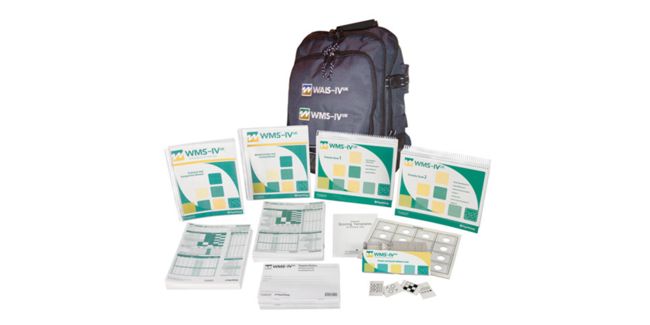
Wechsler Memory Scale - Fourth UK Edition (WMS-IV UK) - Reviews

Professor Jane L Ireland, School of Psychology, University of Central Lancashire

The first difference that will undoubtedly be noted between the fourth edition of this test and its predecessor is its complete revision. It would be more aptly described as a revolution of this test than an evolution. The timing for such a significant change was perfect with regards to advances in the literature over recent years, and a growing application of such tests to a range of diverse populations, including forensic groups.

The only downside, however, is for the avid users of the WMS-III who will have to break from their well-developed administration skills and learn what is effectively a ‘new’ test. Previous knowledge of the WMS-III is simply not required: WMS-IV is more than a simple updating, it is an impressive revision. For example, a range of subtests have been removed from the WMS-III to create the WMS-IV, namely Faces, Family pictures, Word Lists, Letter-Number Sequencing, Digit Span, Spatial Span, Information and Orientation, and Mental Control.

This has proven very helpful for administration to forensic populations since what appears to have been removed are the subtests which can, advertently, cause considerable frustration to forensic clients with impulsivity or affect disorders – anyone who has tried to administer Letter-Number Sequencing to an offender with a low tolerance threshold will certainly appreciate the sentiment here.

What comes with this revolution in revision, however, is an entirely updated administration manual that now provides an excellent core basis for both clinical and research interpretation and application. The manual includes invaluable detail on the rationale for the changes, and the importance of such a significant revision. In addition to the removal of tests, three of the original tests have also been modified, with four new tests developed, one of which includes a Brief Cognitive Status Exam. This latter test will be particularly helpful to practitioners who are after a quick ‘sketch’ of initial ability.

The WMS-IV has also sought to solve some of the previous difficulties across a range of areas such as the rather limited previous range of normative samples available, to enhance the practical interpretation of the scores, to increase the comparability with broader tests such as the WAIS-III, and to improve content, reliability and, importantly, clinical application.

Within forensic practice there is certainly a need to assess more routinely the full extent of memory difficulties that our clients present with. Too often such assessments are either not completed, are rudimentary in nature, or do not respond to the engagement style of such a client group. The value of obtaining a full assessment of immediate memory (auditory and visual), delayed (auditory, visual and auditory recognition), general and working memory is essential both for research and practice purposes, and is aptly provided via the WMS-IV.

With regards to the research, there is a need for research exploring memory in depth, with the majority of alternative tests tending to focus on working memory, immediate recall and inattention. For offenders, research application is broad, and we can use tests such as the WMS-IV to explore how memory correlates with substance disorders, information processing (e.g. hostile interpretations; and regulation disorders that result in anger loss and impulsivity etc), offence recall and denial, witness recall, suggestibility and compliance, executive functioning, cognitive interviewing, and a range of clinical disorders, to name but a view.

The potential research application of tests such as the WMS-IV are thus significant, and could assist with the development of theories into offence engagement and treatment responsivity. With regards to this area, specifically the area of practice, the value in assessing memory in detail has application to the whole remit of forensic practice, whether this involves completing treatment or assessments with victims, perpetrators and/or witnesses.

Tests such as the WMS-IV can provide practitioners with a detailed individual profile that can assist with an indication of how treatment, assessments or interviews can be best matched to an individual’s learning style. Treatment and interviews can sometimes suffer from a lack of information on memory profile which the practitioner can then utilise to ensure that they attend to the responsivity needs of their clients. The WMS-IV now provides one possible solution to this.

As noted earlier, although other memory tests do exist, none provide the depth of memory assessment in such an accessible form for use with forensic clients, as does the WMS-IV. This is an important point, particularly when you are dealing with offenders who present with attention and/or impulsivity difficulties, where being able to focus their attention for long periods of time can be challenging for even the most skilled practitioner.

The WMS-IV has such a variety of tests that the management of these challenges are really assisted, with tests presented to clients in an engaging fashion, and importantly, in a way which does not automatically engender ‘failure’. The latter is a vital area to be aware of when dealing with clients who may routinely present with a self-depreciating style and/or a proness to feeling ‘punished’.

Thus, I warmly recommend the WMS-IV to any practitioner or researcher who has a keen interest in understanding the complexities of memory, and in applying the most up-to-date assessments to benefit their clinical and research practice. It should provide an invaluable further tool in the repertoire of clinical and research assessments available.

Date Added: 26 May 2010

Key Information

Description

Assess verbal and non-verbal memory abilities in adults

Author(s)

David Wechsler

Publication Year

2010

Age Range

16 years to 90 years 11 months

Administration

Individual - 75 minutes

Qualification Code

CL1


£804.00 (Complete kit price from)