
WAIS-5 UK available now!
Launch dates:
14 Aug 2026: Paper-only complete kits and components
24 Sep 2026: release on Q-global®
12 Nov 2026: release on Q-interactive®
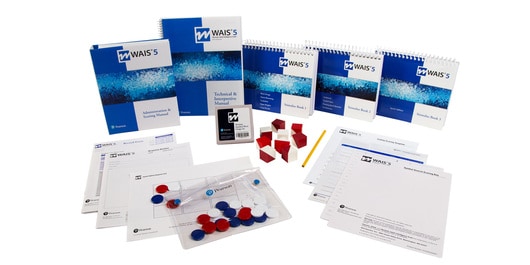
Wechsler Adult Intelligence Scale | Fifth UK Edition
WAIS-5 UK
The Wechsler Adult Intelligence Scale® - Fifth UK Edition (WAIS®-5 UK) is the most advanced adult measure of cognitive ability, based on recent research cognitive neuroscience and the theories and work of David Wechsler, PhD. Guidance on using this test in your telepractice.WAIS-5 UK available now!
Launch dates:
14 Aug 2026: Paper-only complete kits and components
24 Sep 2026: release on Q-global®
12 Nov 2026: release on Q-interactive®
INTRODUCTION TO THE WAIS 5 UK - 15 SEPTEMBER
A103000461916
Qualification Level
- Publication date:
- 2026
- Age range:
- 16:0–90:11
- Qualification level:
- C
- Completion time:
- 45 minutes for the 7-subtest FSIQ; 60 minutes for the 10 primary index subtests
- Administration:
- Paper or Q-interactive®
- Scoring options:
- Paper or Q-global®
- Telepractice:
- Guidance on using this test in your telepractice
Overview
The Wechsler Adult Intelligence Scale®, Fifth Edition (WAIS-5 UK), the most comprehensive and reliable assessment of cognitive ability now features reduced administration time, updated norms, improved clinical utility, and improved user experience.
As an added benefit, WAIS-5 UK has been co-normed with WMS-5 to increase the precision of IQ and memory comparisons.
Features and benefits
- New later start points for those suspected of intellectual giftedness
- Decreased testing time
- New index scores for examinees with expressive or motor problems
- Improved interpretive clarity
- Measure of ability not confounded by expressive language or motor problems
- Separate visual spatial and fluid reasoning indexes
- Purer measure of both constructs
- Improved interpretive clarity
- Comprehensive measurement of working memory
- Auditory, visual, spatial, capacity, and focus of attention
- Task that mimics real-world rate of speech
- New quantitative reasoning index
- Strong indicator of general intelligence and predictor of academic and career success
- New crystallised and fluid expanded index scores
- Broader measures of the two cornerstones of intelligence
The WAIS-5 UK is currently in development and will be available in late 2026.
Changes in the test structure include new and separate Visual Spatial and Fluid Reasoning index scores and new measures of verbal reasoning, motor-reduced processing speed, and expanded fluid reasoning and working memory. To augment the primary index scores, the GAI and the FSIQ, 14 new ancillary index scores are also available: verbal (expanded crystallised), verbal reasoning, expanded visual spatial, expanded fluid, quantitative reasoning, expanded working memory, visual working memory, auditory working memory-registration, auditory working memory manipulation, expanded processing speed, motor-reduced processing speed, non-verbal, non-motor, and cognitive proficiency. Each of the five cognitive domains features an expanded index score, which is useful if a closer evaluation of one or more domains is needed (e.g., to provide more information about an unusual discrepancy between two subtests of a primary index), or if a particular application requires it (e.g., qualification for Access Arrangements, admission to programmes or organisations for intellectually gifted individuals).
The changes were influenced by contemporary structural models of intelligence, neurodevelopmental theory and neurocognitive research, clinical utility and factor-analytic studies.
The separation of Visual Spatial and Fluid Reasoning index scores results in greater interpretive clarity. The addition of visual working memory enhances the scale's clinical utility due to domain-specific differentiation of working memory abilities. Four of the new ancillary index scores that sample from multiple cognitive domains can be useful for examinees with special circumstances (e.g., extreme expressive language impairment or decline, extreme motor impairment or decline), or for certain applications (e.g., comparisons with measures of another construct, such as memory or achievement).
Yes. Substantial efforts were made during development to achieve the shortest testing time possible and still offer greater construct coverage and flexibility. As a result, administration time is shorter than that of the WAIS–IV UK. For the heart of the test, the primary index scores, the subtests take less time (about 10 minutes) to administer than the WAIS–IV UK. The FSIQ, now with only seven subtests, can be obtained about 20 minutes faster than the WAIS–IV UK. Because administration time is determined by the composite scores desired, it varies based on the practitioner's choices. The WAIS-5 UK provides 10 secondary subtests to expand the clinical utility. If you opt to administer these subtests, the testing time will be somewhat longer.
The WAIS-5 UK Non-motor Index (NMI) can be easily applied in remote testing situations. All testing can take place in the remote environment because no manipulatives or response booklets are required. The testing time required to obtain the NMI is slightly less than that of the FSIQ, which is desirable in tele-assessment situations. A similar non-motor score developed by Raiford (2017) has been recommended for remote assessment (Wright & Raiford, 2021).
The NMI can be interpreted similarly to the FSIQ as a measure of general intellectual ability that eliminates the requirement for motor production. There are some differences in task demands across the two scores that might result in slightly different conceptualisation of the FSIQ and the NMI. The cognitive processes involved in Visual Puzzles, unlike Block Design, do not involve visual-motor integration or trial-and-error problem-solving with feedback. Furthermore, Visual Puzzles may place slightly greater demands on mental rotation. Coding and Naming Speed Quantity each involve cognitive speed and visual scanning. Coding involves encoding and rapidly retrieving newly encoded associations and graphomotor speed, but Naming Speed Quantity involves rapid retrieval of frequently used and overlearned long-term associations and very simple expressive responses.
Item Number: A103000450907: WAIS-5 UK Response Booklet (Print) Package of 25
Item Number: A103000450902: WAIS-5 UK Coding Scoring Template in Envelope (Print)
Item Number: A103000450903: WAIS-5 UK Symbol Search Scoring Key in Envelope (Print)
Item Number: 9780749170424: Wechsler Standard Block Design SetThe questions remain the same, but the sample responses were updated slightly to account for societal and language changes. The scoring criteria for all items are revised.
Coding did not change. The Symbol Search items and the font and spacing are different. Both subtests are administered on paper with the response booklet and are not available digitally on Q-interactive.
Set Relations: New Fluid Reasoning subtest designed to measure logical deductive reasoning, fluid intelligence, and simultaneous processing. It may also involve working memory and crystallised knowledge.
Running Digits: New Auditory Working Memory subtest designed to measure registration and maintenance, including refreshing and updating information held in short-term storage while processing additional stimuli. It is designed to measure aspects of the central executive and episodic buffer and the focus of attention.
Naming Speed Quantity: New Processing Speed subtest designed to measure numerical processing fluency and the ability to recognise and label quantities efficiently (subitising).
Spatial Addition: A measure of Visual Working Memory designed to measure visual spatial working memory and requires storage, manipulation, and ability to ignore competing stimuli (also included on WMS®-IVUK and WMS-5UK).
Symbol Span: A measure of Visual Working Memory designed to measure the capacity to hold a mental image of a design in mind and the relative spatial position on the page (also included on WMS-IVUK and WMS-5UK).
There are three stimulus books, but only two of them (i.e., Stimulus Books 1 and 2) are required to administer the subtests that are used to derive the five primary index scores, the FSIQ, and 12 of the 15 ancillary index scores. Stimulus Book 3 contains the Spatial Addition subtest, which is needed to derive the remaining three ancillary index scores.
There is only one response booklet containing the Coding and Symbol Search subtests.
Yes, both the Administration and Scoring Manual and the Technical and Interpretive Manual will be available in the Q-global Resource Library for purchase, as well as the Response Booklet (for demonstration purposes) and all three Stimulus Books.
- Composite scores are often described in qualitative terms according to the examinee’s level of performance relative to same-age peers. The descriptors are useful for clear communication of results to individuals who are unfamiliar with quantitative test results. Qualitative descriptors are only suggestions and are not evidence-based; alternate terms may be used as appropriate.
Related Items