For the TOD with British English TOD-S Forms, please click here.
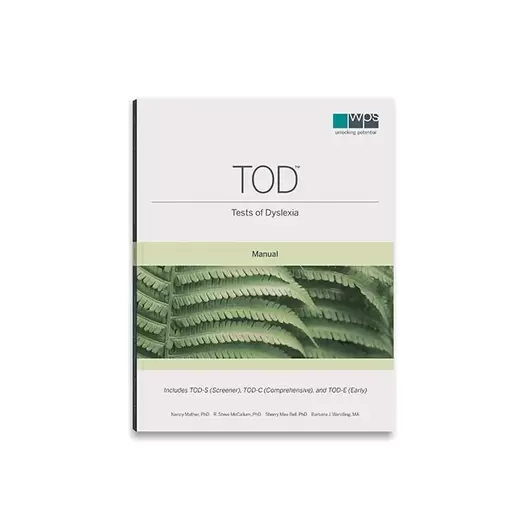
Tests of Dyslexia American English
TOD™ US
The Tests of Dyslexia (TOD) is a comprehensive assessment tool designed to identify and diagnose dyslexia in individuals aged 4 to 70. It helps professionals measure a variety of cognitive and linguistic skills, including phonological processing, word reading, and spelling. The TOD provides a detailed analysis to assist in creating targeted intervention plans. The tool is ideal for educators, psychologists, and clinicians involved in dyslexia screening and diagnosis.For the TOD with British English TOD-S Forms, please click here.
TOD Training Video Program, LMS-705
A103000406485
Qualification Level
Please note: This product requires manual provisioning by the original publisher. This manual process may take some additional time after your purchase.
This online self-study video program does not include a certificate of attendance.
Access code required. You will receive access codes and redemption instructions in your order confirmation email and your Order history.
- Publication date:
- 2024
- Age range:
- Grade K through adulthood; ages 5 years, 0 months–89 years, 11 months
- Scores/Interpretation:
- Standard and composite scores, percentile ranks, confidence intervals, age- and grade-equivalents; growth scores for monitoring progress. TOD Rating Scales provide T-scores, percentiles, confidence intervals, and level of risk
- Qualification level:
- B
- Completion time:
- TOD-S: 10–15 minutes; TOD-E: additional 20–25 minutes after TOD-S; TOD-C: additional 30–40 minutes after TOD-S to obtain DDI, LPI, and RSI with additional tests at 5-10 minutes each
- Administration:
- TOD-S can be administered to individuals or groups; TOD-C and TOD-E are individually administered; available in digital or paper formats
- Norms:
- 2,518 individuals aged 5 to 89 in standardization and validation studies. Standardization sample closely matches U.S. Census data for gender, race/ethnicity, parents’ educational level, and geographic area
TOD UK Recommendations
There are essential guidelines for UK users to ensure that Americanisms in the Tests of Dyslexia (TOD) are adapted to British English, making the assessments more accurate and relevant.
The Tests of Dyslexia (TOD) consists of three sets of direct assessments: TOD-Screener (TOD-S), TOD-Early (TOD-E), and TOD-Comprehensive (TOD-C). The tests measure skills and abilities across three domains: reading and spelling; linguistic processing; and vocabulary and reasoning. TOD Parent/Caregiver, Teacher, and Self-Rating Scales gather data on indicators of dyslexia such as family history of reading problems, motivation, and early speech or language difficulties.
Together, the tests can help you create a profile of reading, spelling, and linguistic abilities to identify those who have characteristics consistent with a dyslexia diagnosis. The TOD UK Recommendations Doc provides essential guidelines for UK users, ensuring that Americanisms in the Tests of Dyslexia (TOD) are adapted to British English, making the assessments more accurate and relevant.
TOD Benefits:
Allows practitioners and educators to accurately assess and diagnose dyslexia and specific learning disability in reading, provides risk and probability indexes, and includes intervention recommendations based on assessment results.
Expanded Scoring Information:
Age-based and grade-based standard scores, percentile ranks, confidence intervals, and age- and grade-equivalent scores for each TOD test; Dyslexia Risk Index (TOD-S); Early Dyslexia Diagnostic Index (TOD-E); Dyslexia Diagnostic Index (TOD-C); composite scores in the domains of reading and spelling, linguistic processing, and vocabulary and reasoning; growth scores for monitoring progress. Co-normed TOD Rating Scales provide T-scores, percentile ranks, confidence intervals, and level of risk.
The TOD offers flexible testing configurations, standalone test options, as well as supplemental composites. The TOD-C generates 15 composite scores, and the TOD-E generates 4 composite scores, allowing practitioners to tailor each assessment to the needs of students.
Comprehensive Tests:
Decades of reading research have identified the linguistic skills that underlie reading and spelling abilities, as well as those that are typically affected by dyslexia. In alignment with that research, the TOD measures:
- Sight Word Acquisition
- Phonics Knowledge
- Basic Reading Skill
- Decoding Efficiency
- Spelling
- Reading Fluency
- Reading Comprehension Efficiency
- Phonological Awareness
- Rapid Automatized Naming
- Auditory Working Memory
- Orthographic Processing
- Visual–Verbal Paired-Associate Learning
- Vocabulary
- Reasoning
TOD-Screener
This quick screener can be used with individuals or groups to provide a Dyslexia Risk Index (DRI) to show whether a more comprehensive assessment is needed.
TOD-S tests include:
- Picture Vocabulary (not included in DRI)
- Letter and Word Choice
- Word or Question Reading Fluency
TOD-Comprehensive
The TOD-C provides a comprehensive dyslexia assessment which yields a Dyslexia Diagnostic Index (DDI) indicating the probability that an individual has dyslexia. The DDI is based on 2 tests from the TOD-S and 6 additional tests from the TOD-C. Another 14 tests provide a detailed look at skills and abilities related to dyslexia.
TOD-C tests include:
- Phonological Manipulation
- Irregular Word Spelling
- Rapid Letter Naming
- Pseudoword Reading
- Word Pattern Choice
- Word Memory
- Picture Analogies
- Irregular Word Reading
- Oral Reading Efficiency
- Blending
- Segmenting
- Regular Word Spelling
- Silent Reading Efficiency
- Rapid Number and Letter Naming
- Letter Memory
- Rapid Pseudoword Reading
- Rapid Irregular Word Reading
- Symbol to Sound Learning
- Listening Vocabulary
- Geometric Analogies
TOD-Early
The TOD-E assesses each of the early abilities that most clearly indicate dyslexia in young children, yielding an Early Dyslexia Diagnostic Index (EDDI) score. Two TOD-S tests, along with the 6 TOD-E tests, indicate an individual’s risk of dyslexia.
TOD-E tests include:
- Sounds and Pseudowords
- Rhyming
- Early Rapid Number and Letter Naming
- Letter and Sight Word Recognition
- Early Segmenting
- Letter and Sound Knowledge
TOD Rating Scales
TOD-C and TOD-E Parent/Caregiver Rating Scales for grades K through 12 (available in English and Spanish) provide information about:
- family history of reading or spelling difficulties;
- delays in early speech or language development;
- the student’s ability to read, spell, listen, and speak;
- impressions of the student’s abilities compared to others of the same age;
- the student’s attitude toward reading; and
- the amount of support needed for homework and organization.
TOD-C and TOD-E Teacher Rating Scales provide information about:
- the amount of difficulty a student has with reading, spelling, and other classroom tasks;
- whether a student needs extra time to complete assignments;
- how oral language and reasoning skills compare to those of peers; and
- apparent preference for other activities over reading.
TOD-C Self-Rating Scales for Grade 1 through adulthood provide information about:
- attitude toward reading; and
- perception of oral language, word reading, comprehension, and spelling abilities.
The following resources are available for TOD.
Videos
- Introduction to the Tests of Dyslexia (TOD™)
- Unboxing: Overview of the Tests of Dyslexia (TOD™)
- How to Administer the Tests of Dyslexia (TOD™) Remotely
The Tests of Dyslexia (TOD) is a comprehensive battery of tests and resources designed to help identify and plan interventions for individuals of all ages with dyslexia. It is authored by Nancy Mather, PhD, R. Steve McCallum, PhD, Sherry Mee Bell, PhD, and Barbara J. Wendling, MA.
The TOD identifies the risk and probability of dyslexia or specific learning disability in reading in individuals aged 5 to 89. The TOD also provides instruction and intervention recommendations based on assessment results.
The TOD has three batteries: the TOD-Screener, three tests that can be administered to groups or to individuals, available in a paper or digital format; the TOD-Early, designed for the early identification of students in Grades K–2 (5 years, 0 months–9 years, 3 months); and the TOD-Comprehensive, designed for examinees from Grade 1 to adulthood (6 years, 0 months–89 years, 11 months).
- Indexes designed to indicate the risk and probability of dyslexia
- Composites and tests that measure reading skills (untimed and timed), spelling, specific linguistic risk factors (phonological awareness, orthographic processing, rapid automatized naming, and working memory), and vocabulary and reasoning abilities
- Self, Parent, and Teacher Rating Scales designed to indicate risk of dyslexia as well as capture qualitative indicators of dyslexia, such as a family history of reading problems and early difficulties with speech and language
- The Dyslexia Interventions and Recommendations guide to help examiners develop IEPs and targeted intervention plans to address specific skill weaknesses
First, the TOD covers a wide age range and includes the major components that are needed for a comprehensive dyslexia assessment. There is no need to cobble together results from different tests with different norm groups.
Second, the TOD includes the reading and linguistic abilities that are most relevant to the diagnosis of dyslexia. The TOD includes measures of word recognition (untimed and timed), phonics knowledge, reading fluency, and comprehension efficiency (the ability to comprehend text under time pressure).
The TOD also includes linguistic risk factors (e.g., phonological awareness, rapid automatized naming) that can help determine the factors that are affecting reading development.
Third, the TOD includes measures of vocabulary and reasoning to help determine if the reading problem is specific and/or unexpected in relation to abilities that do not require reading.
Fourth, the TOD includes rating scales to help standardise the process of collecting information from parents, teachers, or individuals being assessed.
Fifth, the TOD includes a guide to interventions to help develop an instructional plan.
Professional standards in testing are presented in the Standards for Educational and Psychological Testing published by the American Educational Research Association (AERA), American Psychological Association (APA), and the National Council on Measurement in Education (NCME).
Examiners should use only those tests for which they have the appropriate training and expertise. All the TOD components can be purchased by educators, psychologists, and related professionals who serve students who may have dyslexia.
These are Level B tests, so examiners must have a bachelor’s degree in psychology or a related discipline (e.g., school counselors, speech and language pathologists, social workers, special education teachers, medical professionals) and training and instruction in administration and interpretation of standardised tests.
The components of the TOD can be used by a variety of clinicians and educators. For example, a classroom teacher may administer the TOD-Screener and complete the Teacher Rating Scale. Reading specialists, educational diagnosticians, psychologists, and speech–language pathologists are best suited to administer the TOD-Early or the TOD-Comprehensive due to their advanced coursework and experience with standardised tests.
Teachers who are trained to administer the test and are supervised by professionals who have advanced training with standardized assessments may also administer the TOD-E or TOD-C.
Interpreting test results requires a higher level of skill. For that reason, while a broader range of individuals can administer the test, interpreting results requires knowledge of dyslexia and formal training in test administration, scoring, and interpretation.
The TOD-S can be administered digitally on OES and scored automatically or can be administered on paper.
The TOD-C and TOD-E can only be administered on paper (although PDF easels are available for remote/digital administration, responses are recorded/scored on a paper record form).
When administered on paper, the TOD-S, TOD-C, and TOD-E can be hand-scored or scored on OES for free. This free online scoring and reporting provides a convenient alternative to hand-scoring as well as an interpretive score report and access to a customizable intervention report.
The rating scales included in the TOD-C, TOD-E, and TOD Combination kits are only available on our Online Evaluation System™ (OES) at platform.wpspublish.com. Once you use the activation code on the OES, you can print out any of the Parent, Teacher, or Self-Rating Forms at no extra cost and as many times as you want if you prefer to administer any forms on paper. However, you still have to score the response forms online, which gives you access to beneficial reporting options.
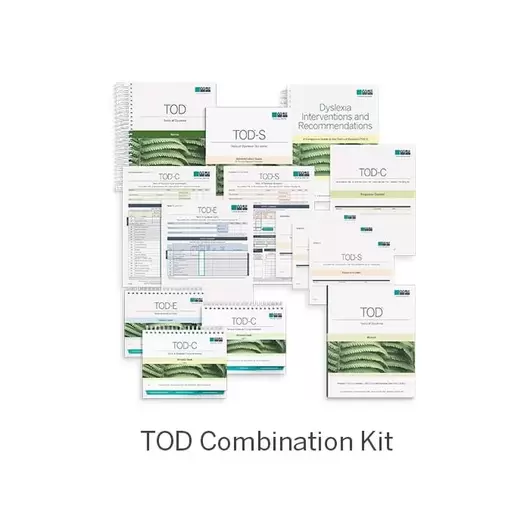
You may purchase any of the TOD kits (Combination, Screener, Early, or Comprehensive), all of which include forms, manual, and intervention planner, or you may purchase individual items.
The answer to this question is complicated and requires some context.
Reliability and validity evidence occurs over time and from multiple studies and methodologies. It cannot be defined by single scores. Expert recommendations for interpreting reliability and validity estimates are produced by statistical equations. In general, the reliabilities of the tests and composites are almost all >.80 and thus support the stability of the TOD across tests and over time.
Several studies provide validity evidence for the TOD. Confirmatory factor analyses support the factorial structure of the Dyslexia Risk and Diagnostic Index scores, as well as the component Reading and Spelling and Linguistic Processing Index scores.
Additionally, concurrent validity analyses demonstrate that each TOD test correlates in expected ways with other tests of similar constructs. Most importantly, comparisons between typically developing individuals and those with a diagnosed reading disability show that the latter group performs more poorly on the TOD measures.
This disparity in performance represents a clinically meaningful difference. Furthermore, at a cutoff score of 80, the TOD-S Dyslexia Risk Index discriminates individuals with a reading disability from typically developing individuals with sensitivity of ≥.80 and specificity of ≥.99; the TOD-C Dyslexia Diagnostic Index does so with sensitivity of ≥.78 and specificity of ≥.97; and the TOD-E Early Dyslexia Diagnostic Index does so with sensitivity of ≥.80 and specificity of ≥.99.
2,518 individuals aged 5 to 89 participated in the standardisation and validation studies.
The TOD normative samples are TOD-C child (n = 1,401); TOD-C adult (n = 342); and TOD-E (n = 347). The TOD-S was taken by individuals in each of the three samples and serves as the basis for the TOD-S standardisation.
Each sample closely matches U.S. Census data based on gender, race/ethnicity, parents’ educational level, and geographic region.
The remaining individuals made up the clinical validation samples and had a reading disability and/or other clinical diagnosis.
The TOD manual, norms, administration booklet, intervention guide, and TOD-E and TOD-C easels are available in pdf digital format.
Examiners can use the TOD-E and TOD-C pdf easels for remote administration, but paper materials, record forms, and response booklets are still required.
Free online scoring for TOD-S, TOD-C, and TOD-E is available on the WPS Online Evaluation System (platform.wpspublish.com). The TOD-Screener is available as a paper kit or an online kit with full online administration capabilities, without the use of paper materials.
TOD Rating Scales are administered and scored online only, but a paper version can be downloaded for use with parents, teachers, or individuals who do not have online access at no extra cost.
Examiners will need to enter the responses into the Online Evaluation System to obtain the score.
Yes we do - They can be found here.