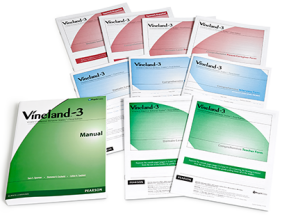
Vineland Adaptive Behaviour Scales | Third Edition
Vineland-3
Vineland Adaptive Behavior Scales, Third Edition (Vineland-3) is the leading instrument for supporting the diagnosis of intellectual and developmental disabilities. Vineland-3 not only aids in diagnosis, but provides valuable information for developing educational and treatment plans. Guidance on using this test in your telepracticeUser Level B Training (Adaptive Behaviour) · On Demand
A103000360922
Qualification Level
Audience
This on-demand training is designed for professionals working as social workers, Allied Health professionals, primary and secondary teachers, special educators, learning support staff , and other professionals working in the Education or Health industry who are interested in using the Vineland 3, and other User Level B assessments, in their practice.
Course Structure
The training is comprised of three units. We suggest you allow 8-15 hours to complete on-demand units. This time will vary based on the User Level B assessment category and the number of on-demand units.
Unit 1 – Introduction to Statistical Concepts
Unit 1 will focus on introducing statistical concepts and principles that underpin all User Level B assessments. This unit will specifically discuss:
- Sets of scores and how to describe them
- The measures of central tendency
- Standard deviation and measures of spread
- Ordinal and categorical data
- Converting raw scores to z and t scores
- Interpretation considerations
Unit 2 – Understanding User Level B assessments
Unit 2 will focus on improving your understanding of the User Level B assessment portfolio and your capacity in using User Level B assessments in context. The unit will specifically discuss:
- Developing an assessment hypothesis based on a referral
- User Level B assessment categories
- User Level B direct assessment administration principles
- Reporting considerations
Unit 3 – Vineland Administration, Scoring and Interpretation
Unit 3 will focus on contextualising the statistical principles you have learned through the introduction to one of our leading User Level B assessments, the Vineland 3. The unit will specifically discuss:
- Overview of the Vineland
- Administration of the Vineland
- Scoring of the Vineland
- Interpretation considerations when using the Vineland
Learning Outcomes
After undertaking this training, participants will be able to:
Unit 1
- Use and interpret both descriptive and inferential statistics
- Compare sets of scores in classroom
- Understand and be able to interpret measures of spread, deviation scores and standard deviation
- Use and interpret the foundations of standard scores, including z and t scores and the normal distribution
Unit 2
- Develop a testable hypothesis based on a referral
- Describe and detail the various assessments that comprise the User Level B portfolio
- Describe the difference between direct and indirect assessments
- Undertake a User Level B direct assessment ensuring that best practice guidelines are understood and adhered to
- Generate an assessment report
Unit 3
- Understand the general administration principles and practice guidelines of the Vineland 3
- Adhere to scoring principles and practices of the Vineland 3
- Explain basic interpretation considerations when using the Vineland 3
- Adhere to ethical considerations when using the Vineland 3
- Understand Vineland 3 resources
Once you’ve completed the training, you’ll be able to purchase all our gold-standard User Level B assessments and will have one month of free digital access to the following test manuals and stimulus books:
- Vineland-3
- PEDI-CAT
- Sensory Profile
- EVT-3
- Movement ABC 3
- BOT-3
- WIAT-III A&NZ
- BASC BESS
- Bracken School Readiness Assessment
Prerequisites
To attend our User Level B (Adaptive Behaviour) training, you will need to:
- Register on our website
- Have a tertiary degree level education
While it is no longer mandatory to acquire an “approved mentor” to supervise your scoring and reporting of User Level B practice assessments, we strongly recommend that you do so to ensure your administration and practice of assessment usage is accurate.
Your mentor should be an existing User Level B or C and have at least 6-12 months of experience using User Level B assessments.
Looking for bespoke group training solutions?