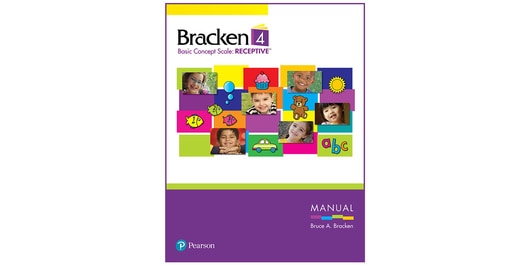
Bracken Basic Concept Scale | Fourth Edition: Receptive
BBCS–4:R
The Bracken Basic Concept Scale, Fourth Edition: Receptive™ (BBCS–4:R™) is a developmental assessment designed to evaluate children's school readiness in terms of their understanding of basic concepts that are strongly related to early childhood cognitive and language development as well as early academic achievement.BBCS-4:R and BSRA-4 Administration & Scoring Review, Development, and Technical Characteristics On Demand 2 Hours
A103000371034
Qualification Level
- Publication date:
- Late 2022
- Age range:
- 3:0 through 7:11 years
- Scores/Interpretation:
- BBCS–4:R: School Readiness Composite (SRC) and Receptive Total Composite (Receptive TC) standard scores, School Readiness Subtests (SRS) and subtests 7–10 scaled scores, percentile ranks, concept age equivalents, growth scale values, and descriptive classifications.
- Qualification level:
- B
- Completion time:
- School Readiness Composite (SRC): 15–20 minutes; Total Receptive Total Composite (RTC): 20–40 minutes
- Administration:
- Q-interactive®, Q-global®, paper-and-pencil
- Scoring options:
- Q-interactive, Q-global, and manual scoring
- Report Options:
- Q-interactive score report, Q-global score report
The BBCS–4:R is Now Available!
When can you expect the BBCS–4:R?
- Paper and pencil administration: Now available
- Q-global scoring and reporting: Now available
- Q-interactive administration and scoring: April 2023 (please note, this will be the first new product built for the new Q-interactive Assess app that provides a brand-new user experience based on customer feedback!)
The BBCS–4:R is a developmental assessment used to assess children’s school readiness skills in terms of their comprehension of basic concepts used in daily classroom conversations, teacher directions, and school curricula. Concept knowledge is a powerful predictor of language development, cognitive functioning, and school readiness. The BBCS–4:R is especially important for psychologists who assess children with developmental delays, autism, selective mutism, and hearing impairments, educators seeking to determine a child's school readiness, and speech-language pathologists evaluating concept development. Test results are compared to national norms.
Benefits
BBCS–4:R aids in:
- Determining if a child has mastered the basic concepts that are related to school readiness
- Identifying deficits in concept development and planning interventions
- Comparing assessment outcomes to each state’s early childhood educational standards
- Facilitating the developmental assessment of children with limited verbal expression (e.g., children with autism, selective mutism, or children who are shy/reticent) by using a pointing response mode
- Comparing children’s receptive and expressive conceptual knowledge with the BBCS–4:R and Bracken Basic Concept Scale: Expressive (BBCS:E)
- Assessing diverse populations of children (artwork is inclusive, developmentally appropriate, colorful, and engaging)
- Assessing Spanish-speaking students (includes Spanish translation of the BBCS–4:R and the BBCS:E Record Forms)
Features
BBCS–4:R details
- The BBCS–4:R provides the most comprehensive assessment of concept development available, assessing more than 280 important concepts across these 10 subtests:
- Colors
- Letters
- Numbers/Counting
- Sizes/Comparisons
- Shapes
- Self-/Social Awareness
- Direction/Position
- Texture/Material
- Quantity
- Time/Sequence
- Commonly used in early childhood classrooms by teachers giving directions and presenting curricular material, the BBCS–4:R concepts correspond to school curricula and educational standards across all 50 states.
- BBCS–4:R items and artwork were reviewed for content and cultural bias by speech-language pathologists and education specialists focused on the assessment of diverse populations. Note: More technical information to come when reliability and validity studies are completed in 2022.
- Includes more than 150 concepts across STEM/STEAM domains
- Assess advanced concepts that can be used to identify children as candidates for Gifted and Talented programs
Scoring and Reporting
Automated scoring and reporting
When using Q-interactive via two Bluetooth®-connected iPad®s, examinee responses are recorded and scored on the examiner’s iPad. BBCS–4:R automatically calculates the child’s School Readiness Composite standard score (SRC), School Readiness Subtests (SRS) scaled score, remaining subtest scaled scores, percentile ranks, concept age equivalents, normal curve equivalents, and growth scale values.
When the BBCS–4:R is administered using print or Q-global digital assets, examiners may manually score or use Q-global to enter subtest item scores or subtest raw scores. Q-global will quickly and accurately generate a report with the child’s School Readiness Composite standard score (SRC), School Readiness Subtests (SRS) scale score, remaining subtest scaled scores, percentile ranks, concept age equivalents, normal curve equivalents, and growth scale values. Q-global also enables examiners to maintain and print test records, create graphical and summary reports, and provide evidence-based techniques for teaching concepts.
The following resources are available for BBCS-4:R.
- BBCS–4:R vs BBCS–3:R Product Comparison
- BBCS/BSRA flyer
- Top 5 Benefits of Digital for BBCS–4:R and BSRA–4
Sample Reports
General
The new editions of these tests include:
- Digital administration and scoring options are available on Pearson’s Q-global® and Q-interactive® platforms.
- Updated normative data based on US Census figures (2019).
- BBCS–4:R School Readiness Subtests (SRS) and Composite (SRC) scores are based on six subtests instead of five subtests. The subtest added to the SRS and SRC scores is the Self-/Social Awareness subtest, which was Subtest 7 on BBCS–3 and was not included in BSRA–3.
- Assesses more than 150 foundational science, math, and arts concepts across STEM/STEAM domains.
- Provides a measure that can be used as part of the process that helps professionals identify students for Gifted and Talented programs.
There are no updates planned for the BBCS–3:E at this time. You may continue to use the BBCS–3:E; however, remember that the BBCS–4:R and BBCS–3:E are not co-normed, so test results are not directly comparable. BBCS–4:R and BBCS–3:E are based on research samples collected in different years and with a different demographic composition.
While trained A-level practitioners may administer and score using the basal and ceiling rules, a B-level individual with training in normative test interpretation is needed to interpret and explain scores and score differences from prior administrations.
Paraprofessionals or A-level staff working under the supervision of a qualified assessment professional may administer and score, but not interpret, the BSRA–4. Paraprofessionals and A-level staff should be carefully trained and supervised and should administer and score several practice cases before attempting their first actual testing.
Test Administration
- BBCS–4:R now has age start points and basal rules.
- The School Readiness subtests and subtests 7–10 now include age start points, basal, and discontinue rules to reduce test administration time.
Scoring
- Scaled Score
- Standard Score
- Percentile Rank
- Age Equivalent
- Growth Scale Value
- Descriptive Classification
Yes.
Subtests 1–5 predict academic success in the traditional sense since they are based on academic subject matter. Subtest 6 also predicts academic success from a social standpoint. Therefore, if a child's SRS/SRC score predicts poor academic success, the examiner may want to review whether it is lack of knowledge of the academic curriculum or if it is delayed development specifically in self-/social awareness only.
Technical information
A summary of the technical characteristics of the BBCS–4:R and the BSRA–4 will be posted on the product web page’s resources tab later this summer.
Spanish version
A translation of the English record form is available. You will be able to report concepts that a Spanish-speaking child understands in Spanish; however normative scores are not available at this time.
Complimentary assessment overviews and training
Learn more about BBCS–4:R and how to use it with fidelity.
Whether you’ve purchased this assessment or need additional information to help make your purchase decision, we’ve got complimentary on-demand, introductory training to help guide you.
Register for Brainshark to access the brief assessment overview, including a description of the components, types of scores provided, and applicable clinical populations.
Next Steps
Once you are logged in*, you will find the complimentary training in the Content Portal. If you do not see the Complimentary Training group, contact Customer Support (link to https://www.pearsonclinical.co.uk/contact-us.html) and we will add it to your profile.
*If you are a new registrant, you will receive an email with the subject line, “Your Brainshark Username and Password” from noreplies@brainshark.com. This email will contain your username and temporary password. You will be prompted to reset your password when you log in for the first time.
Looking for more in-depth training?
Browse paid training options for BBCS-4:R or contact your assessment consultant for guidance on training that aligns with your needs.
The following webinars are available for BBCS-4:R
