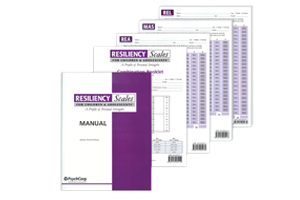
Resiliency Scales for Children and Adolescents
RSCA
Resiliency Scales for Children & Adolescents™ A Profile of Personal Strengths (RSCA) is a tool to profile personal strengths, as well as vulnerability in teens and children- Publication date:
- 2006
- Age range:
- 9-18
- Reading Level:
- 3rd grade
- Scores/Interpretation:
- T scores for global scales Scaled scores for subscales
- Qualification level:
- B
- Administration:
- 5 minutes per scale
- Forms:
- Three stand-alone global scales
- Norms:
- Representative of the U.S. population within gender by ethnicity and parent education level for children ages 9-18
The RSCA measures the personal attributes of the child that are critical for resiliency. Assessing resilience is important as it levels influence outcomes of many disorders.
Benefits
- Build positive psychology into assessment practice through strength identification and enhancement.
- Use separately, together, or in conjunction with other symptom-based measures to obtain a balanced view.
- Identify children who indicate low personal resources or high vulnerability before emergence of symptoms.
- Compare a child’s experience of personal resources with his or her experience of emotional reactivity.
- Easily interpret and discuss results with children, teachers, and parents.
Features
Scales are comprised of three stand-alone global scales of 20 to 24 questions each and ten subscales.
- Sense of Mastery Scale: assesses optimism, self-efficacy, and adaptability.
- Sense of Relatedness Scale: assess trust, support, comfort, tolerance.
- Emotional Reactivity Scale: assess sensitivity, recovery, impairment.
- Scales focus on strengths as well as symptoms and vulnerabilities.
- Third-grade reading level allows use with those who have special needs, including reading difficulty.
- Normed and compatible with the Beck Youth Inventories Second Edition to link a Resiliency Profile with specific symptoms for more targeted treatment planning.
The following resources are available for Resiliency Scales for Children & Adolescents: A Profile of Personal Strengths.
Creating a Clinical Psychology of Resilience
Resilience explains why some children overcome seemingly overwhelming obstacles while others become victims of their early experiences and environments.
Canadian Journal of School Psychology
The Canadian Journal of School Psychology has dedicated a special issue on “Resiliency: Translating Theory into Application for Children and Adolescents,” with Dr. Sandra Prince-Embury as the guest editor.
Comparison of One-, Two-, and Three-Factor Models of Personal Resiliency Using the Resiliency Scales for Children and Adolescents
Sandra Prince-Embury and Troy Courville
This article examines the scale structure of the Resiliency Scales for Children and Adolescents (RSCA).
Measurement Invariance of the Resiliency Scales for Children and Adolescents With Respect to Sex and Age Cohorts
Sandra Prince-Embury and Troy Courville
This article examines invariance of the three-factor structure of the Resiliency Scales for Children and Adolescents across age band and gender within normative samples.
The Resiliency Scales for Children and Adolescents, Psychological Symptoms, and Clinical Status in Adolescents
Sandra Prince-Embury
Using the School-Companion Sensory Profile 2 to support a child in third grade who is becoming more socially isolated.
