|WISC-IV is available in the Q-interactive Assessment library
Use Q-interactive, Pearson's interactive digital assessment platform, to create unique, client-centric batteries at both the instrument and subtest levels.
Find out more >|
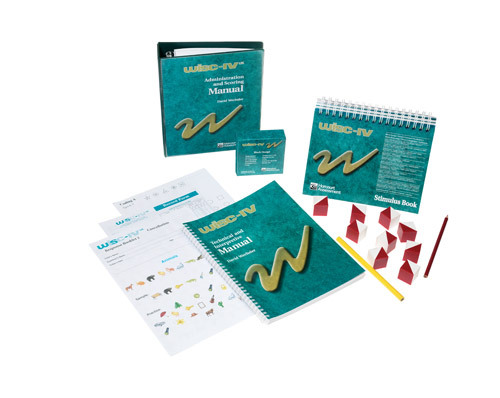
This fourth generation of the most widely used children’s intellectual ability assessment meets your testing needs for the twenty-first century.
Read WISC-IV review >|
While maintaining the integrity of the Wechsler tradition, the Wechsler Intelligence Scale for Children® - Fourth UK Edition (WISC-IVUK) builds on contemporary approaches in cognitive psychology and intellectual assessment, giving you a new, powerful and efficient tool to help develop and support your clinical judgements.
Even Stronger Clinical Utility
Understanding of learning difficulties and attentional disorders has greatly expanded since the publication of the WISC–IIIUK. WISC–IVUK makes important advances from previous editions in order to provide the most effective clinical tool representing cutting edge research and thinking. This timely revision is the result of over a decade of research and success with the WISC–IIIUK.
Benefits of WISC–IVUK
-
Expand and strengthen clinical utility to support your decision-making
-
Develop the four Index Scores as the primary interpretive structure
-
Improve the assessment of fluid reasoning, working memory and processing speed
-
Improve subtest reliabilities, floors and ceilings from WISC–IIIUK
-
Co-normed with the recently published WIAT–IIUK (which replaces the WOND, WORD and WOLD)
-
Updated, colourful, child-friendly artwork
-
Instructions to both the examiner and the child are improved to make the WISC–IVUK even more user friendly.
Three WISC–IIIUK subtests have been eliminated from WISC–IVUK: Object Assembly, Mazes and Picture Arrangement. WISC–IIIUK subtests that are now supplemental include Picture Completion, Arithmetic and Information.
New Subtests
Several new subtests are added to reflect current clinical knowledge and practice:
-
Word Reasoning - measures reasoning with verbal material; child identifies underlying concept given successive clues.
-
Matrix Reasoning - measures fluid reasoning (a highly reliable subtest on WAIS–IIIUK and WPPSI-III UK); child is presented with a partially filled grid and asked to select the item that properly completes the matrix.
-
Picture Concepts - measures fluid reasoning, perceptual organisation, and categorisation (requires categorical reasoning without a verbal response); from each of two or three rows of objects, child selects objects that go together based on an underlying concept.
-
Letter-Number Sequencing - measures working memory (adapted from WAIS–III); child is presented with a mixed series of numbers and letters and repeats them numbers first (in numerical order), then letters (in alphabetical order).
-
Cancellation - measures processing speed using random and structured animal target forms (foils are common non-animal objects).
-
In addition, new optional recall procedures have been added to the Coding subtest, including free recall, cued digit recall and cued symbol recall.
Four Composite Scores
In order to make interpretation more clinical meaningful, the dual IQ and Index structure from WISC–IIIUK has been replaced with a single system of four composite scores (consistent with the Four Index Scores in WISC–IIIUK) and the Full Scale IQ.
This new system helps you better understand a child’s needs in relation to contemporary theory and research in cognitive information processing.
Want to see this product?
Our Sales Consultants can offer free, no obligation product demos. They can attend team meetings, in-service study days or regional conferences, either as speakers or to exhibit relevant materials. Click arrange a visit| to book an appointment.
ALSO AVAILABLE! Save time and effort in generating reports with the WISC-IV – WIAT-II UK Writer|.
Related links:
Read a review of WISC-IV in Aspire magazine (Issue 5) >| (3MB)